| 브랜드 이름: | Hoan |
| 모델 번호: | JGX-0958D-108A |
| MOQ: | 10개 |
| 지불 조건: | L/C,D/A,D/P,T/T,웨스턴 유니온 |
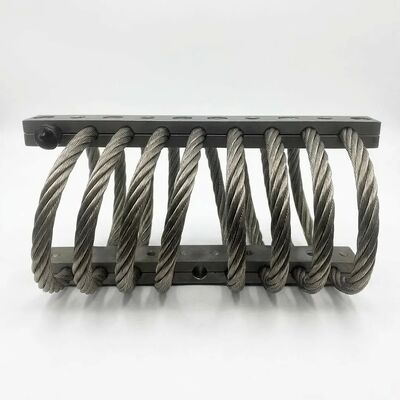
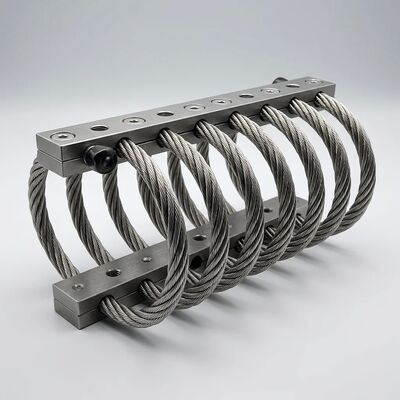
A wire rope vibration isolator is a passive mechanical device that attenuates vibration energy through the principle of Coulomb friction damping—dry friction generated between individual steel wire strands as the rope coil flexes under load. Unlike elastomeric (rubber) mounts that convert vibration energy into heat within the material matrix, the JGX-0958D-108A dissipates energy at the microscopic interface between its 133 individual wires (7 strands * 19 wires per strand), creating a maintenance-free, particle-free damping mechanism that does not degrade with age or temperature cycling.
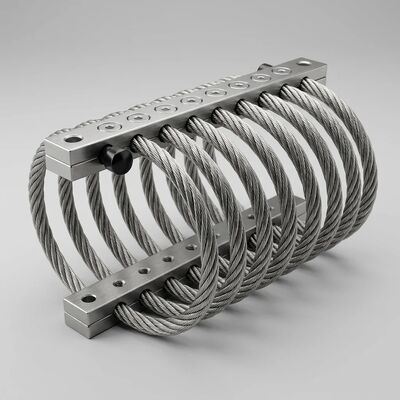
The JGX-0958D-108A consists of three components: a helically wound 7*19 stainless steel 304 wire rope (6.4 mm nominal diameter, 8 active loops), upper and lower 6061-T6 aluminum alloy clamping blocks with a hard anodized surface finish, and four M10 stainless steel fastening bolts. When mounted between a vibration source and the protected structure, the wire rope coil flexes in response to input excitation, generating controlled inter-strand friction that converts kinetic energy into negligible heat while providing both stiffness (load support) and damping (energy dissipation) in a single compact element.
One of the persistent challenges in vibration isolator selection is the gap between catalog data and real-world installed performance. Static load ratings tell you whether the isolator can support the weight; they do not tell you how it will behave dynamically at your specific excitation frequency, mounting orientation, and attachment stiffness. Traditionally, closing this gap requires ordering samples, building test fixtures, running shaker table characterization, and iterating—a process that typically consumes 2–3 weeks per design cycle.
The JGX-0958D-108A addresses this with pre-validated FEA simulation models included as engineering collateral. Each model has been correlated against physical test data from a 6-DOF electrodynamic shaker table, achieving simulation-to-measurement accuracy within ±5% for these key outputs:
These models are delivered in a format compatible with Ansys Mechanical, Abaqus, and COMSOL Multiphysics, allowing your structural dynamics team to drop the JGX-0958D-108A directly into a system-level model and evaluate isolation performance before committing to hardware procurement.
When production machinery relies on vibration isolators that are no longer manufactured—because the original supplier discontinued the product line, changed their tooling, or went out of business—the equipment owner faces an unpalatable set of choices: accept degraded isolation performance from aging mounts, commission a costly custom re-design, or replace the entire machine. The JGX-0958D-108A platform offers a fourth option through its integrated reverse engineering service.
ISO 14644-1 cleanroom classifications impose strict limits on airborne particulate concentration. A single elastomeric vibration mount in a Class 5 (ISO 5 / FED STD 209E Class 100) semiconductor fab can shed enough microscopic rubber particles over its 3–5 year service life to trigger particle count excursions during routine environmental monitoring. Wire rope isolators eliminate this failure mode at the component level.
The JGX-0958D-108A’s damping mechanism is purely mechanical: as the 133 individual stainless steel wires within the 7*19 rope construction slide against one another during flexure, they generate controlled friction without abrasion, without shedding, and without requiring lubrication. There are no elastomeric elements, no adhesive bonds, no coatings that can delaminate, and no organic materials that can outgas in vacuum environments. The hard anodized surface on the 6061-T6 aluminum clamping blocks provides wear resistance without generating aluminum oxide dust. This makes the JGX-0958D-108A suitable for:
| Parameter | Value | Test Standard |
| Model Number | JGX-0958D-108A | — |
| Isolator Type | Wire Rope Vibration Isolator, Helical Coil | — |
| Wire Rope Construction | 7 * 19 (7 strands, 19 wires per strand = 133 wires) | ISO 2408 |
| Wire Rope Material | AISI 304 (UNS S30400) Stainless Steel | ASTM A313 |
| Wire Rope Diameter | 6.4 mm ± 0.15 mm | ISO 2408 |
| Individual Wire Diameter | 0.28 mm (center) + 0.26 mm (inner layer) + 0.22 mm (outer layer) | — |
| Clamping Block Material | 6061-T6 Aluminum Alloy | ASTM B211 |
| Clamping Block Surface | Hard Anodized, 25–50 μm thickness, 350–400 HV hardness | MIL-A-8625 Type III |
| Active Coils | 8 loops, symmetric helical winding | — |
| Rated Load – Compression (Z-axis) | 108 kg (1,059 N) | — |
| Rated Load – Shear (X/Y-axis) | 54 kg (530 N) per axis | — |
| Rated Load – Tension (Z-axis) | 36 kg (353 N) | — |
| Static Deflection at Rated Load | 2.5–3.5 mm (compression), 4.0–5.5 mm (shear) | — |
| Dynamic Stiffness (K*) at 0.5 mm, 20 Hz | 380–420 N/mm (compression), 120–150 N/mm (shear) | ISO 10846-2 |
| Loss Factor (η) at 0.5 mm, 20 Hz | 0.18–0.25 | ISO 10846-2 |
| Damping Type | Coulomb (dry friction), amplitude-dependent | — |
| Natural Frequency at Rated Load | 9.5–12.5 Hz (compression), 7.5–10.0 Hz (shear) | — |
| Resonance Amplification (Q) | ≤4 (at resonance, compression mode) | — |
| Transmissibility at 25 Hz | 0.25–0.35 (–12 to –9 dB isolation) | — |
| Transmissibility at 50 Hz | 0.08–0.12 (–22 to –18 dB isolation) | — |
| Shock Attenuation (30 g, 11 ms half-sine) | Peak response ≤15 g (attenuation ≥50%) | IEC 60068-2-27 |
| Operating Temperature Range | -40°C to +200°C | — |
| Salt Spray Resistance | 500+ hours, no red rust (passivated SS304) | ASTM B117 |
| Endurance Life | ≥1 * 107 cycles at rated load, 10 Hz, ±1.5 mm | — |
| Mounting Bolts | M10 * 1.5 mm pitch, A2-70 Stainless Steel (4 bolts) | ISO 898-1 |
| Bolt Torque | 35–40 N·m | — |
| Mounting Pattern | 120 mm * 80 mm (length * width, center-to-center) | — |
| Overall Dimensions | 140 mm (L) * 95 mm (W) * 65 mm (H) ± 1.0 mm | — |
| Unit Mass | 0.85 kg ± 0.03 kg | — |
| Certifications | ISO 9001:2015, RoHS 2011/65/EU | — |
| Property | JGX-0958D-108A Wire Rope | Typical Elastomeric (NBR/CR) Mount |
| Damping mechanism | Coulomb friction (inter-wire) | Viscoelastic hysteresis (molecular) |
| Service life at 25°C | 15+ years (no degradation) | 3–5 years (oxidative aging) |
| Temperature range | -40°C to +200°C | -20°C to +80°C (typical) |
| Stiffness drift over 5 years | ≤2% | +15–40% (progressive hardening) |
| Damping drift over 5 years | ≤3% | -20–50% (loss of damping) |
| Oil and chemical resistance | Excellent (SS304 + anodized Al) | Poor to moderate (solvent swelling) |
| UV and ozone resistance | Immune (all-metal) | Poor (surface cracking) |
| Particulate generation | Zero | Moderate (rubber abrasion dust) |
| Outgassing in vacuum | None (all-inorganic) | Significant (plasticizers, cure residuals) |
| Fire resistance | Non-flammable (melting point >1,400°C) | Combustible (auto-ignition ~350°C) |
| End-of-life disposal | 100% metal recycling (revenue) | Mixed waste incineration/landfill (cost) |
| Damping at small amplitude (<0.1 mm) | Lower (stiffer response) | Higher (softer response) |
| Damping at large amplitude (>1.0 mm) | Higher (friction activation) | Lower (material saturation) |
What does the model number JGX-0958D-108A mean? The “JGX" prefix identifies the manufacturer’s wire rope isolator product family. “0958" is the size and configuration code for this envelope class. “D" designates the dual-clamp mounting configuration (two aluminum blocks capturing the wire rope coil). “108" is the rated compression load in kilograms. The “A" suffix indicates the standard configuration with SS304 wire rope and 6061-T6 aluminum blocks.
Can I use the FEA model with my existing simulation software? The pre-validated FEA models are delivered in a neutral file format importable into Ansys Mechanical (v2021 R2+), Abaqus (6.14+), COMSOL Multiphysics (5.6+), and Nastran (via bulk data deck). If your team uses a different solver, contact our applications engineering group for format conversion support.
What is the minimum information needed to start a reverse engineering project? We need the existing isolator’s envelope dimensions (a photograph with a scale reference is often sufficient for initial assessment), an estimate of the supported mass, and the dominant vibration frequency or operating speed of the machine. From these three inputs, our applications team can scope the project and provide a firm quotation within 2 business days.
Does the hard anodized surface wear off over time? The Type III hard anodize layer is 25–50 μm thick with a Vickers hardness of 350–400 HV. In normal industrial service, the clamping block surface that contacts the wire rope experiences negligible wear because the rope-to-block interface is static (no sliding motion)—all damping motion occurs within the wire rope coil itself.